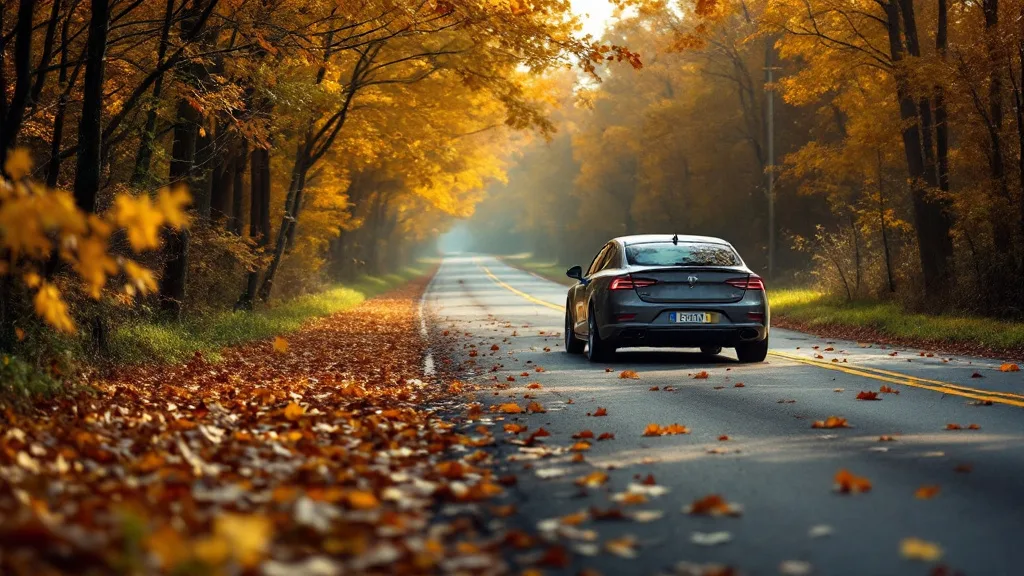
 Illustration
Driving on wet leaves in the North Country: what to know this fall
Wet leaves, farm equipment, school buses, low sunlight, frost and deer can create seasonal driving hazards in Northern New York, according to safety guidance from AAA Northeast, AARP, New York agencies and the National Highway Traffic Safety Administration.
Fall driving in Northern New York requires extra care around wet leaves, farm equipment, school buses, changing light, frost and wildlife. Wet leaves can hold water on the road and create a surface that AAA Northeast compares to driving on ice. Drivers should slow down before reaching leaf-covered areas and leave additional space for braking.
How dangerous are wet leaves on the road?
Wet leaves can be extremely slippery because their waxy surfaces hold water. AAA Northeast says drivers should treat wet leaf coverage much like an icy surface, while AARP advises braking before reaching a patch of leaves rather than waiting until the vehicle is on top of it.
Leaves can also hide potholes and other road hazards. Drivers should reduce speed, avoid abrupt movements and watch for changes in pavement that may not be visible beneath the leaves.
Where should drivers avoid parking in the fall?
Drivers should not park over piles of dry leaves because heat from a vehicle's exhaust system or catalytic converter can ignite them. AAA Northeast advises leaving space between a parked vehicle and leaf piles.
Keeping leaves away from the underside of a vehicle is especially important during dry conditions. Drivers should also check around the vehicle before leaving, particularly where leaves have collected along the road or curb.
What should North Country drivers know about tractors and school buses?
Drivers must follow the same passing rules for farm equipment as they do for cars and motorcycles, and New York law prohibits passing slow-moving vehicles in no-passing zones. That is especially important during harvest season, when tractors and other farm equipment are more common on roads in Northern New York.
Drivers should not cross a double-yellow line to pass and should use particular caution near hills and curves. Waiting behind a slow-moving vehicle may be safer than attempting to go around it.
School bus traffic also increases the need for attention during morning arrival and mid-afternoon dismissal periods, the National Highway Traffic Safety Administration says. New York drivers must stop at least 20 feet from a school bus with flashing red lights, regardless of the direction of travel.
Violations in New York can bring a $250 fine for a first offense and up to $1,000 for three violations within three years, along with points. Camera-based penalties assessed to a vehicle owner are $250 for a first violation, followed by $275 and $300 for later violations.
Why are fall mornings and evenings more difficult to drive in Northern New York?
Shorter daylight, low autumn sun and glare can reduce visibility during morning and evening travel. AARP advises drivers to account for longer glare periods at dawn and dusk as the sun's position changes through the season.
Overnight temperatures near freezing can produce frost and icy spots, especially on bridges and in shaded areas. Drivers should allow extra time, use caution on potentially slick surfaces and make sure heating, defrosting and windshield-wiper systems are working properly.
These conditions can affect travel across Northern New York, including the Watertown area, Jefferson, Lewis and St. Lawrence counties, Fort Drum and the Tug Hill region. Roads that pass through open farm country, wooded areas or shaded stretches may change quickly as temperatures and light conditions shift.
When are deer and moose most active near North Country roads?
Deer are more visible on New York roads from October through December, which the state Department of Motor Vehicles and Department of Environmental Conservation identify as deer breeding season. Drivers should watch the road edges and be especially alert during lower-light periods.
The DMV and DEC reported that 41% of deer-vehicle crashes in 2021 occurred during those three months. New York also has an estimated Adirondack moose population of about 700, so drivers in and around the Adirondacks should remain alert for larger wildlife as well.
If a deer appears near the roadway, drivers should slow down and avoid sudden swerving. Wildlife often travels in groups, so a second animal may follow the first.
Where to get help or more information
Drivers can review passing rules in the New York State DMV driver's manual at dmv.ny.gov/new-york-state-drivers-manual-and-practice-tests/chapter-6-passing. The National Highway Traffic Safety Administration provides school-bus safety guidance at nhtsa.gov/school-bus-safety/keeping-children-safe.
AAA Northeast and AARP provide additional fall-driving guidance on wet leaves, glare, parking near leaf piles and seasonal visibility. New York's DMV and DEC provide information about deer and moose near roadways and fall wildlife risks.
For a dead deer that creates a road hazard, the source material lists 1-800-FIX-ROAD, or 1-800-349-7623, for removal.
Common questions
- How slippery are wet leaves?
- Wet leaves can be extremely slippery because their waxy surfaces hold water. AAA Northeast compares driving on wet leaves to driving on ice, and AARP advises braking before reaching leaf-covered patches.
- How can I avoid a fall driving fire?
- Do not park over piles of dry leaves. Heat from a vehicle's exhaust system or catalytic converter can ignite leaves beneath the vehicle.
- When are deer most active in Northern New York?
- New York DMV and DEC identify October through December as deer breeding season, when deer are more visible near roads. Drivers should be especially watchful during dawn and dusk.
- What should I know about tractors on roads near Watertown and Tug Hill?
- Farm equipment is more common during harvest season in Northern New York. Drivers must follow the same passing rules that apply to cars and motorcycles and cannot pass in a no-passing zone.
- How far back must I stop for a New York school bus?
- New York drivers must stop at least 20 feet from a school bus with flashing red lights. The rule applies to traffic approaching from either direction.
- Why are fall mornings risky on North Country roads?
- Shorter daylight, low sun, frost and icy spots can reduce visibility and traction. Bridges and shaded areas can be particularly slick when overnight temperatures approach freezing.
- What should I do about a dead deer in the road?
- If a dead deer creates a safety hazard on a state road, report it for removal at 1-800-FIX-ROAD (1-800-349-7623).
More from ClickNNY
Tell us what we missed
Know something North Country readers should hear about this? Send the ClickNNY desk a local tip, a correction or a photo.